
Put the next paving campaign beside the crew schedule
Give the campaign manager a brief the scheduler and estimator can support. The scheduler supplies the actual resource opening, and the estimator supplies the pending decisions that could fill it. Marketing then has a service and area to pursue for a known period.
Editorial Team
Paving Marketers
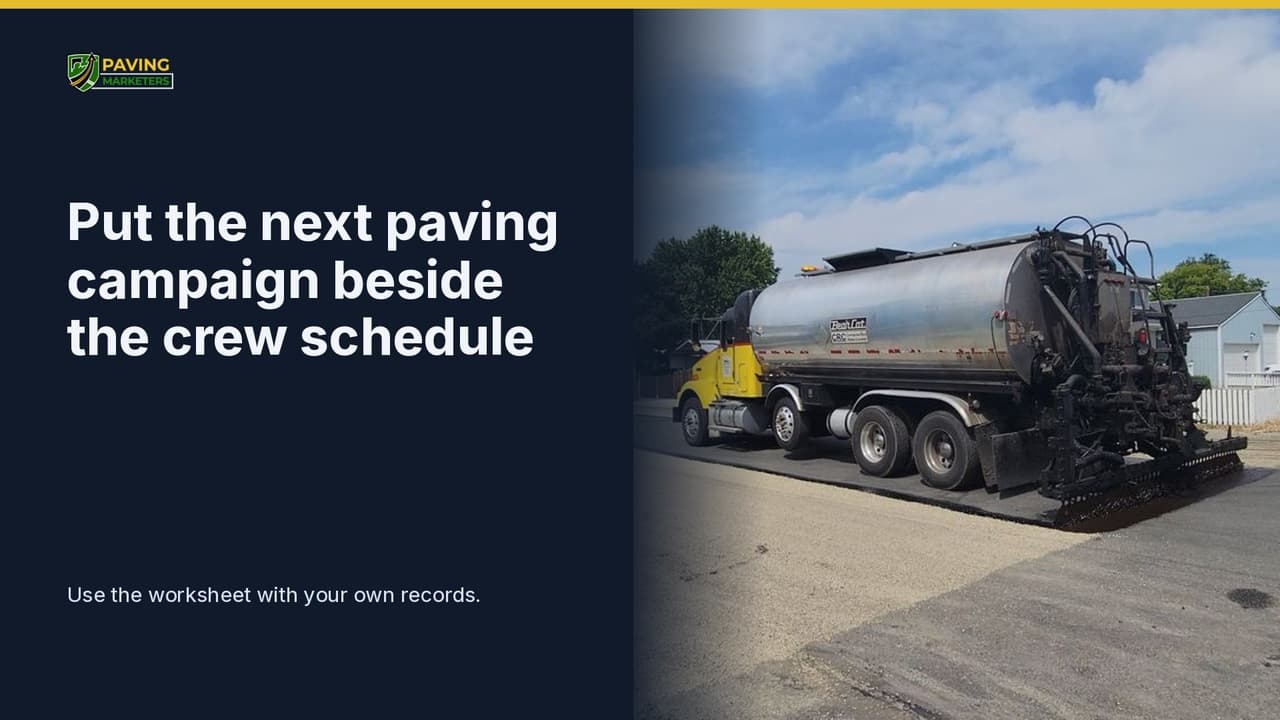
Give the campaign manager a brief the scheduler and estimator can support. The scheduler supplies the actual resource opening, and the estimator supplies the pending decisions that could fill it. Marketing then has a service and area to pursue for a known period.
Work through the capacity and lead-time examples below before changing spend. Keep the schedule with your operating team while the campaign responds to the work they can take.
1. Show capacity for the crew that can perform the work
Ask the scheduler to show each crew's available time after committed jobs and known constraints, using comparable crew-days where that fits the operation. A paving day and a maintenance day need separate rows when different people or equipment perform the work.
Here is how that distinction changes one planning week:
| Resource | Available days | Committed days | Planning allowance | Uncommitted days |
|---|---|---|---|---|
| Paving crew | 5 | 4 | 1 | 0 |
| Pavement-maintenance crew | 5 | 2 | 1 | 2 |
The uncommitted figure is available days minus committed days and the allowance. The sample allowance is a planning choice, not a weather forecast or an industry standard. Your scheduler should set it from the operation's actual constraints.
The total of two open days does not mean any two-day paving project will fit. It means the maintenance resource has an opening. Confirm the service, equipment, travel and crew requirements before attaching a marketing action to it.
2. Put pending decisions alongside the schedule
Ask the estimator for open work that could fill the relevant period. Keep it in a separate view until accepted work is actually scheduled.
| Pending work | Resource needed | Buyer stage | Decision expected | Earliest workable start | Next action |
|---|---|---|---|---|---|
| Retail-lot maintenance | Maintenance crew | Bid submitted | Week 2 | Week 4 | Confirm decision date |
| Office-site striping | Maintenance crew | Visit arranged | Unknown | Week 3 | Complete assessment |
| Commercial resurfacing | Paving crew | Scope question | Unknown | Unconfirmed | Resolve proposed area |
These are sample records. Have the estimator supply a crew-day estimate when the scope supports one. Leave it unknown while assessment is incomplete. Once work is accepted and scheduled, move it into committed capacity and avoid counting it in both views.
You can use historic stage probabilities when you have sound data, but the useful first version needs no guessed percentages. A bid with a real decision date and next action can guide this week's work without being presented as a forecast.
3. Work backward through your actual lead time
Pull comparable completed jobs for the service you want to promote. Record first lead, assessment, bid, acceptance and start dates. Look at the range as well as a typical value, especially when commercial approval is slow.
For illustration, three comparable jobs took 18, 25 and 41 days from lead to acceptance. The median is 25 days. Three jobs help frame the discussion, but do not establish a dependable promise about the next lead.
If the open week is ten days away, a new commercial campaign may enter the process too late. The estimator's pending decisions may offer a more useful near-term action. A gap farther out gives acquisition more time, provided that the eventual work fits the resource and season.
4. Give marketing a decision it can execute
Use this brief for the weekly discussion:
| Brief field | Fill with your operation's information |
|---|---|
| Resource and service | [crew/equipment and work] |
| Area | [confirmed coverage] |
| Open period | [dates and available capacity] |
| Relevant bids | [IDs with decision dates and next actions] |
| Lead-time evidence | [comparable jobs and their stage dates] |
| Marketing action | [campaign/page/follow-up change] |
| Owner and review date | [responsible person and review date] |
For the sample above, the action might be to pursue suitable maintenance work for a later opening while the estimator resolves current bids. It would be a poor brief to tell the campaign manager to generate any paving lead immediately.
Keep promises consistent with what the office can schedule. When the schedule changes, have the next review connect the reason to the campaign brief. Weather or an equipment problem can move a job even when marketing brought suitable demand. Follow the fit leads into assessments and accepted work, then check the days actually scheduled before judging the campaign's contribution.
Paving Marketers can plan and manage the campaign, commercial page and supported follow-up around that brief. Your scheduler supplies real capacity, and your estimator owns the scope. That gives marketing something more useful to pursue than an empty space on a calendar.
Download the working files
Share this article
Help others discover this content
About Paving Marketers
We work on the search visibility and advertising behind a paving company's estimate requests. The website needs to explain the work you handle, and the follow-up needs to help your team keep track of the people who contact you.
Learn more about usContinue Reading

Give every open commercial paving bid a next decision
When several estimators have bids out, “we're following up” can hide a lot of unfinished work. The property manager waiting for a budget meeting needs a different follow-up from the warehouse contact waiting for your access plan. If another buyer never received the revised estimate, the office has a

You're Invisible to AI — And You Don't Even Know It
Local homeowners and commercial property managers are asking AI assistants for local paving contractor recommendations every day. If your paving company isn't structured for AI search, you are losing asphalt, concrete, and driveway projects to competitors without even knowing it. Here is how to fix your AI visibility this week.

How to Use AI Tools to Save Time on Marketing Without Losing Your Voice
Discover how paving contractors can use AI tools to quickly generate social media updates, follow-up emails, and project spotlights—without losing the authentic, hard-earned reputation that keeps local clients calling.